


Anti-Collision Device (ACD) for Tower Crane – Buy ACD for Safer Crane Operations
When multiple tower cranes are operating on the same construction site, the working areas of their jibs, hooks and loads can overlap. This creates a serious risk of crane-to-crane collision, contact with structures and entry into restricted areas.
A reliable Anti-Collision Device (ACD) for tower cranes helps operators identify these risks and provides warnings or control commands before a dangerous movement develops.
TYB Infra Solutions offers Anti-Collision Devices (ACD) for tower cranes for sale, along with support for selection, installation, commissioning and service.
Whether you are operating a single tower crane near restricted areas or several cranes on a large high-rise project, an appropriately configured ACD can add an important layer of protection to the crane operation.
What is an Anti-Collision Device for Tower Crane?
An ACD, or Anti-Collision Device, is an electronic crane safety system designed to monitor the working range and movement of a tower crane.
Depending on the system configuration, sensors and control electronics can monitor parameters such as:
- Slewing angle
- Trolley position
- Hook position
- Crane working radius
- Crane-to-crane distance
- Height-related interference
- Defined prohibited zones
- Movement direction and speed
- Other configured site parameters
For multi-crane projects, individual ACD units can communicate with each other so that the system can identify interference between cranes. Modern anti-collision systems can also be configured with restricted or exclusion zones.
The purpose is simple:
Detect a potential collision early → warn the operator → restrict or stop dangerous movement where the system is designed and interfaced to do so.
Why is ACD Important for Tower Cranes?
Tower cranes operate at considerable height and often have very large working radii. On busy construction sites, two or more cranes may have overlapping operating areas.
For example:
Tower Crane 1
Jib working radius: 50 m
Tower Crane 2
Jib working radius: 55 m
If their working volumes overlap, normal operator coordination alone may not provide sufficient protection against every possible interference scenario.
An ACD can continuously monitor the configured crane positions and working areas and provide the operator with information about potential interference.
Anti-collision standards such as EN 17076:2020 specifically address the management of interference and prohibited zones for tower cranes, including safety functions intended to slow or stop crane movements before reaching a collision limit.
How Does a Tower Crane Anti-Collision Device Work?
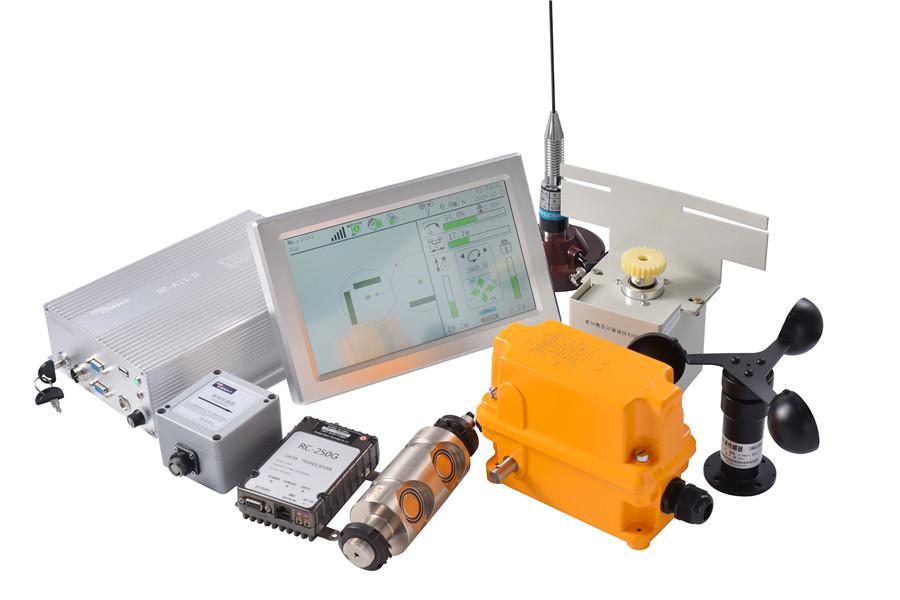
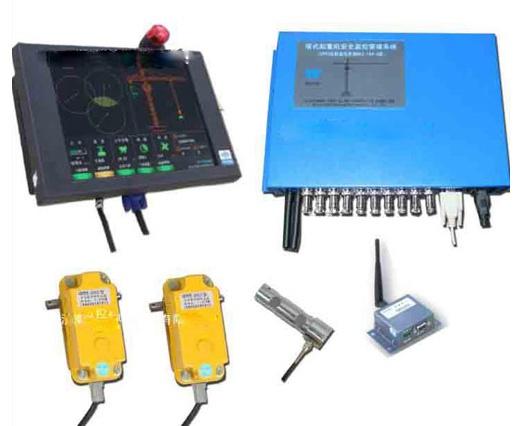
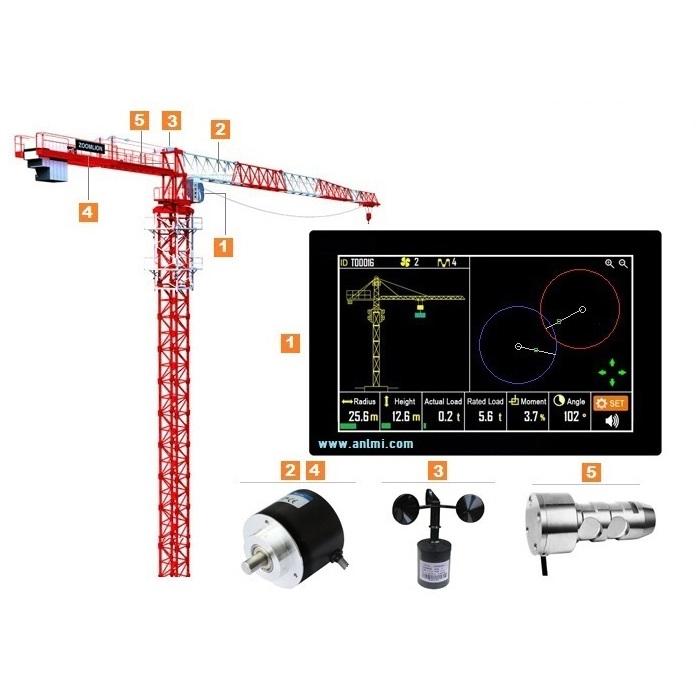
A typical ACD system consists of several components working together.
1. Sensors
Sensors installed on the crane collect movement and position information.
Depending on the system, this may include:
- Slewing/angle sensor
- Trolley position sensor
- Hoisting information
- Height information
- Travel information for travelling cranes
- Other crane-specific sensors
2. Processing Unit
The collected information is transferred to the ACD processor.
The processor compares the crane’s actual position and movement against the programmed safety parameters.
3. Display Unit
The crane operator can see relevant information through a display installed in the cabin or control station.
Depending on the system, the display can show crane position, working zones, warnings and other operating parameters.
4. Communication Between Cranes
For multi-crane installations, ACD systems can exchange information between cranes through a communication network such as radio or cable.
This allows the system to understand the relative positions and operating conditions of neighbouring cranes.
5. Warning and Control
When a crane approaches a configured interference or prohibited zone, the system can generate visual and audible warnings.
Where properly interfaced with the crane control system, the anti-collision function can also issue commands to slow down or stop movement in the hazardous direction.
Key Features of ACD for Tower Crane
The exact features depend on the selected model and crane configuration, but a tower crane ACD can provide:
| Feature | Function |
|---|---|
| Anti-Collision Protection | Helps prevent crane-to-crane interference |
| Zone Protection | Defines restricted or prohibited working areas |
| Real-Time Monitoring | Monitors configured crane movement parameters |
| Slewing Monitoring | Tracks crane rotation |
| Trolley Monitoring | Monitors trolley position/radius |
| Multi-Crane Communication | Allows connected cranes to exchange information |
| Audio Alarm | Warns operator of approaching danger |
| Visual Warning | Displays warning/status information |
| Motion Cut-Off | Can restrict dangerous movement when properly integrated |
| Touch Display | Provides operating information to the operator |
| Ground Monitoring | Available on selected systems |
| Data/Parameter Configuration | Allows site-specific safety zones and parameters |
| Retrofit Installation | Can be installed on existing cranes depending on compatibility |
Modern systems may also integrate additional safety functions such as Safe Load Indicator (SLI/LMI), depending on the selected configuration.
ACD for Multiple Tower Cranes
One of the most important applications of an Anti-Collision Device is a multi-crane construction site.
When several tower cranes operate simultaneously, their jibs and loads can enter overlapping working volumes.
An appropriately configured anti-collision system can coordinate the cranes and identify potentially dangerous interference.
Example
Imagine a project with:
- Tower Crane 1
- Tower Crane 2
- Tower Crane 3
All three cranes are working within the same project boundary.
Without an integrated anti-collision system, operators have to rely heavily on communication, visibility and coordinated operating procedures.
With an ACD system, the crane positions and configured safety zones can be monitored electronically.
This provides an additional layer of protection against accidental overlap.
Zone Protection for Tower Crane
ACD systems are not limited to crane-to-crane protection.
They can also be configured to manage prohibited or restricted areas.
Examples can include:
- Adjacent buildings
- Roads
- Property boundaries
- Sensitive structures
- Restricted construction areas
- Power-line exclusion areas
- Other cranes
- Areas where lifting operations are not permitted
The exact zone-protection capability depends on the ACD model and its installation configuration.
The concept is to create a defined operating boundary so that the crane does not freely enter an unsafe or prohibited working area.
ACD Installation for Existing Tower Cranes
You do not necessarily need a new tower crane to install an anti-collision system.
Many ACD systems are designed for retrofit installation on existing tower cranes, subject to compatibility and the crane’s control system.
TYB can help customers identify the appropriate ACD configuration based on:
- Tower crane make
- Crane model
- Jib length
- Maximum radius
- Crane height
- Number of cranes
- Crane arrangement
- Required exclusion zones
- Existing electrical/control system
- Required communication system
A proper installation should include configuration, calibration and functional testing before the crane is put into normal operation.
ACD for Hammerhead and Luffing Jib Tower Cranes
Anti-collision systems can be used for different tower-crane configurations, subject to the selected system’s compatibility.
Hammerhead Tower Crane
For conventional horizontal-jib tower cranes, the system can be configured around parameters such as:
- Slewing angle
- Trolley position
- Working radius
- Crane height
- Adjacent crane position
Luffing Jib Tower Crane
Luffing-jib cranes have different movement characteristics, so the anti-collision configuration needs to account for the jib angle and corresponding working envelope.
For either type, the system should be selected according to the actual crane and project configuration rather than simply choosing a generic ACD.
What is Included in an ACD System?
Depending on the model selected, a typical ACD package may include:
| Component | Purpose |
|---|---|
| Display | Operator information and warnings |
| Processor/Control Unit | Processes crane data |
| Angle/Slewing Sensor | Measures crane rotation |
| Position Sensors | Determines configured crane movement |
| Communication Module | Communication between cranes |
| Power Supply | Provides system power |
| Connecting Cables | Electrical connections |
| Alarm/Indicator | Operator warning |
| Interface Components | Integration with crane controls |
Some systems can also incorporate additional sensors and equipment depending on the project requirements.
Benefits of Installing ACD on Tower Crane
1. Improved Crane Safety
The primary purpose of an ACD is to reduce the risk of crane collisions and unsafe entry into defined zones.
2. Better Operator Awareness
The operator receives information about crane position and potential interference rather than relying entirely on visual observation.
3. Multi-Crane Coordination
Multiple cranes can be connected in an anti-collision network where supported by the system.
4. Restricted Zone Management
Specific areas can be configured as prohibited or restricted working zones.
5. Reduced Risk of Equipment Damage
Preventing contact between cranes and surrounding structures can help protect expensive equipment and construction assets.
6. Improved Site Management
Electronic monitoring can complement the site’s crane coordination and lifting procedures.
7. Retrofit Possibility
Suitable ACD systems can be installed on many existing tower cranes, subject to technical compatibility.
ACD vs Manual Crane Coordination
Manual coordination remains important on every construction site. Operators, supervisors and lifting teams still need proper communication and operating procedures.
However, manual coordination has limitations.
An ACD provides an additional electronic safety layer by continuously processing configured crane-position information.
Manual coordination:
Operator → Communication → Decision → Crane movement
ACD-supported operation:
Sensors → Processor → Position/risk evaluation → Warning/control interface
The two approaches should work together rather than being treated as alternatives.
Why Buy ACD from TYB Infra Solutions?
TYB Infra Solutions provides tower crane-related equipment, spare parts and safety solutions for construction and infrastructure applications.
When purchasing an ACD, selecting the correct system is just as important as the device itself.
TYB can assist with the requirements for:
- New ACD supply
- Replacement ACD
- Existing tower crane retrofit
- Multi-crane anti-collision systems
- Zone protection
- Sensors
- Display units
- Control components
- Installation support
- Calibration and commissioning
- Service and maintenance requirements
Our objective is to supply an ACD solution suited to the actual tower crane and project configuration.
How to Select the Right ACD for Your Tower Crane
Before purchasing an ACD, provide the following information:
Tower Crane Details
Make:
Zoomlion / Potain / Liebherr / Konecranes / Sany / XCMG / Fusheng / Other
Model:
Tower crane model
Jib Length:
_____ metres
Crane Height:
_____ metres
Maximum Radius:
_____ metres
Number of Tower Cranes:
_____ cranes
Crane Type:
Hammerhead / Luffing Jib / Travelling
Required Protection:
Crane-to-crane / Zone protection / Both
This information helps determine the appropriate ACD configuration.
ACD for Sale in India
TYB Infra Solutions offers Anti-Collision Devices for Tower Cranes for sale in India.
We can supply solutions for:
- Construction companies
- Infrastructure contractors
- Tower crane rental companies
- High-rise building projects
- Industrial projects
- Metro projects
- Commercial construction
- Residential construction
- Multi-crane project sites
- Tower crane maintenance companies
Availability, specifications and pricing depend on the selected ACD model and project requirements.